







The international container expédition market has recently shown neither a broad-based rise nor a uniform decline. Instead, freight rates across different trade lanes are moving at increasingly different paces, influenced by cargaison volumes, capacity deployment, blank sailings, port efficiency, and regional risks.
The latest data show that the Shanghai Containerized Freight Index (SCFI) edged higher overall. However, performance varied significantly by route: European rates continued to decline, while rates to South America, the Persian Gulf, and the United States posted varying degrees of growth.
01 SCFI Edges Higher as Major Trade Lanes Move in Different Directions
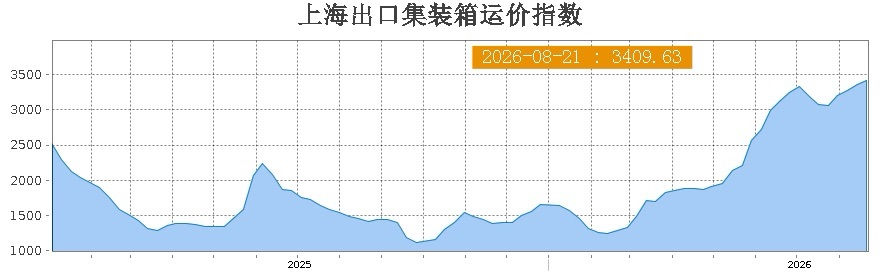
As of August 21, the Shanghai Containerized Freight Index stood at 3,409.63 points, up 1.6% from the previous period.
Rates on major trade lanes were as follows:
- Shanghai to Europe: USD 2,842 per TEU, down 3.5%;
- Shanghai to the Mediterranean: USD 3,767 per TEU, down 4.1%;
- Shanghai to the U.S. West Coast: USD 6,765 per FEU, up 0.8%;
- Shanghai to the U.S. East Coast: USD 9,700 per FEU, up 1.4%;
- Shanghai to the Persian Gulf: USD 5,729 per TEU, up 5.7%;
- Shanghai to Australia and New Zealand: USD 2,315 per TEU, up 2.1%;
- Shanghai to South America: USD 7,805 per TEU, up 9.6%.
Although the overall Chinese export container shipping market experienced only limited fluctuations this week, a closer look at individual trade lanes reveals increasingly divergent rate trends.
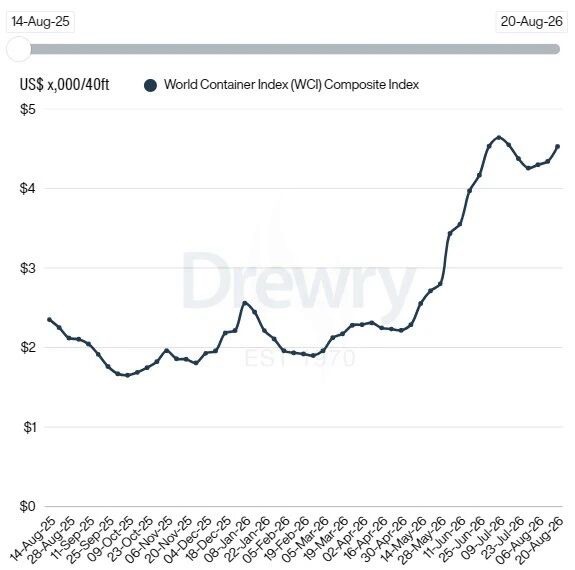
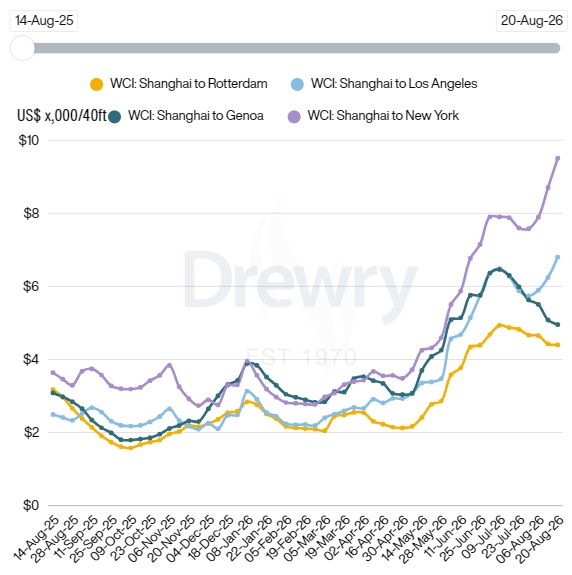
Drewry’s World Container Index (WCI) showed a similar pattern. As of August 20, the WCI had risen 4% to USD 4,526 per 40-foot container, marking its third consecutive weekly increase. Spot rates from Shanghai to both New York and Los Angeles increased by 9%, with trans-Pacific routes serving as the main driver of the latest index rise.
02 European Rates Continue to Correct While South America Rates Strengthen
This week, rates to major European ports fell by 3.5%, while Mediterranean rates declined by 4.1%. In contrast, rates to South America surged by 9.6%, the strongest performance among the major trade lanes.
Europe: Peak-Season Rate Momentum Weakens
Since the beginning of August, spot rates from Asia to Europe have gradually declined. Earlier peak-season increases are now being absorbed by the market, while some rate hikes announced by shipping lines have not been fully implemented.
Although delays remain at some European ports and vessel diversions continue to add transit time and operating costs, these factors have not been sufficient to keep spot rates rising under current cargo volume and capacity conditions.
In the short term, rates on European routes may still leave room for negotiation. However, market averages should be used only as a reference. Actual quotations may vary considerably depending on the shipping line, sailing, destination port, and cargo cut-off date. Shippers should therefore assess each booking based on the specific schedule and service arrangement.
South America: Tighter Effective Capacity Pushes Rates Higher
South American routes have recently been affected by blank sailings, port omissions, weather conditions, and port operating efficiency. As a result, the amount of capacity actually available on certain sailings has decreased, driving rates higher.
The latest increase in South America rates is more likely the result of tighter vessel capacity and limited slot availability than a sudden surge in export demand. This highlights an important feature of the current shipping market: even without a noticeable increase in cargo volume, freight rates may still rise when sailings are reduced, vessel turnaround slows, or port operations are disrupted.
Companies planning shipments to South America should compare not only prices but also verify the following:
- Whether the shipping line can provide confirmed and genuinely available space;
- The earliest executable sailing and estimated departure date;
- The risk of port omissions, cargo rollovers, or transshipment delays;
- The validity period of the quotation and any applicable surcharges;
- Congestion and customs clearance conditions at the destination port.
03 Key Factors Behind Persian Gulf and U.S. Freight Rates
Persian Gulf: Higher Risk Costs and Supply-Side Uncertainty
Rates from Shanghai to the Persian Gulf rose by 5.7% this week, the second-largest increase after South America.
Regional uncertainties and risks surrounding nearby shipping corridors may affect carriers’ routing and operating decisions. Insurance costs, crew safety measures, route adjustments, and emergency transportation arrangements can all increase operating expenses. The market may also price anticipated risks into freight rates in advance.
As a result, freight rates on the Persian Gulf route are not determined solely by cargo volumes. They may also include a certain level of risk premium. For time-sensitive shipments, companies should consider more than the quoted rate and verify:
- Whether vessels will continue to call at the destination port as scheduled;
- Whether routes or transshipment arrangements have changed;
- Whether transit times may be extended;
- Whether the quotation includes temporary surcharges;
- Whether alternative ports or backup routes are available if the original service is adjusted.
U.S. Routes: Capacity Management Supports Short-Term Rates
This week, rates from Shanghai to the U.S. West Coast and East Coast rose by 0.8% and 1.4%, respectively. Drewry data also show that Asia–U.S. East Coast capacity fell by 9% month on month in August, while Asia–U.S. West Coast capacity declined by 0.4%.
Shipping lines continue to manage available capacity through blank sailings, vessel redeployment, and reduced capacity on selected services. The recent resilience of U.S.-bound freight rates reflects both relatively stable demand and tighter capacity.
Spot rates from Shanghai to New York and Los Angeles also recorded notable increases, indicating that localized capacity pressure remains in the trans-Pacific market. However, rate differences among ports, carriers, and individual sailings may continue to widen.
04 Do More Blank Sailings Mean Demand Is Already Weakening?
Freight-rate trends cannot be assessed solely by looking at demand. Carriers’ capacity-management strategies must also be considered.
When cargo growth slows, shipping lines may reduce market supply by cancelling sailings, redeploying vessels, or cutting capacity on selected routes. Under these circumstances, effective capacity can remain tight even without an increase in demand, meaning freight rates may not decline immediately.
Recent developments on U.S. routes illustrate this dynamic. Asia–U.S. East Coast capacity fell by 9% month on month, while capacity to the U.S. West Coast also contracted. Blank sailings remain part of carriers’ capacity-management plans. Therefore, weaker demand does not necessarily lead to an immediate drop in freight rates.
Companies assessing future rate trends should monitor the following indicators:
- Overall cargo volumes and booking demand;
- Carriers’ blank-sailing and service-suspension plans;
- Effective capacity and actual slot availability;
- Vessel schedule reliability and turnaround efficiency;
- Port congestion and terminal operating conditions;
- Changes in temporary and peak-season surcharges;
- Carriers’ future capacity-deployment plans.
A more accurate view of the freight market requires evaluating both demand and supply.
05 Outlook: Route-Level Divergence May Continue
This week’s data indicate that divergence across international shipping routes is becoming more pronounced. European rates remain in a correction phase, South America rates have risen sharply due to tighter effective capacity, Persian Gulf services carry greater uncertainty-related costs, and U.S. routes remain relatively resilient amid capacity reductions.
Short-term freight rates are no longer influenced solely by export volumes. The number of available sailings, vessel turnaround efficiency, port congestion, route adjustments, and regional risks can all change the effective supply of shipping capacity.
Companies with near-term shipment plans should avoid making decisions based only on a composite index or a single quotation. A more prudent approach is to consider delivery deadlines, cargo characteristics, quotation validity, confirmed capacity, schedule reliability, and destination-port capabilities. This allows shippers to strike a better balance between transportation costs and delivery certainty.
About Huiyitong
Huiyitong provides a broad range of international logistics services, including ocean freight, air freight, multimodal transportation, bonded-zone logistics, customs declaration and inspection, cross-border e-commerce logistics, supply chain solution design, and supply chain finance. The company is committed to delivering end-to-end international logistics solutions for businesses.
Market Monitoring
Huiyitong continuously monitors freight rates on major trade lanes, carrier capacity deployment, blank-sailing plans, port congestion, surcharges, and relevant policy changes. This helps identify risks that may affect transportation costs and delivery schedules.
Localized Overseas Services
Supported by its overseas service network, Huiyitong coordinates destination customs clearance, temporary warehousing, and inland transportation. Depending on actual shipping conditions, the company can also help customers evaluate split-shipment arrangements, alternative ports, and backup routing options.
In response to freight-rate fluctuations and schedule adjustments, Huiyitong develops suitable logistics solutions based on customers’ delivery deadlines, cargo characteristics, and transportation requirements, helping businesses improve the stability and flexibility of their international supply chains.